When building and validating behavioural arenas, one of the biggest challenges is cue delivery. As I study olfaction, the cues I am working with tend to be odourants – amino acids, bile salts, etc.
The issue is that these cues are invisible – you can’t see when the cue gets to the fish’s nose and therefore you do not know when to look for specific behaviours as being a response to that odourant.
In many cases, you’ll read a single sentence in the methods section of a manuscript that says something along the lines of “Preliminary tests determined that it took 2 minutes for the cue to be uniformly distributed throughout the tank”, but all too often it remains elusive how that was determined.
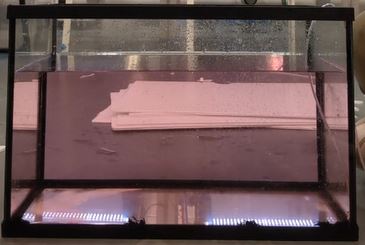
My personal preference to construct (and be confident in) my cue delivery systems involves a very inexpensive reagent: food colouring. If you use a solution of food colouring in the same way you would use a solution of odourant, you can visualize how that colour “cue” moves through the water under your experimental circumstances.
This allows you to determine how long it takes to distribute when you alter factors such as aeration rate, number of cue entry points, cue concentration, and recirculating water flow. The photo series below was taken over the course of about 45 seconds.
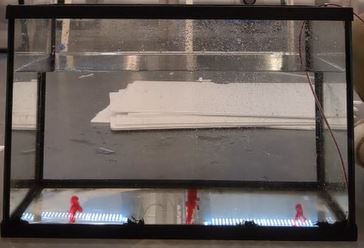


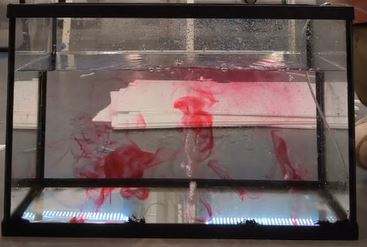
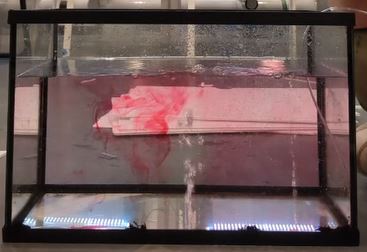
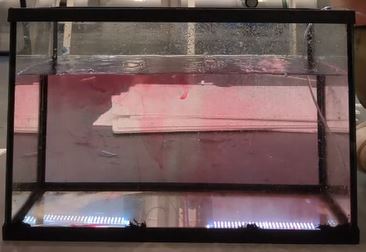
Some bonus tips:
- Red and green food colouring are the best – do not waste your time on yellows, blues, or neons as when they dilute they are difficult to see (especially on video)
- Though not shown in this post, don’t forget to test your colour “cue” with a fish (or whichever organism you are testing) in the tank – you would be amazed at how much of an influence that a swimming fish can have on cue dispersion and how different this is with multiple or larger fish
- Run ultrapure water through all cue delivery components IMMEDIATELY after your colour “cue” test, it flushes it out better than dechlorinated or reconstituted water and prevents any staining of the lines (especially if using polyethylene tubing)