
I was recently out exploring some familiar territory where I grew up. While my family thought we were heading on a leisurely snowmobile ride, I was scoping out some potential field sites for water collection.
Some of my current research is understanding how dissolved organic matter alters fish physiology, and finding sources of suitable organic matter can be a major challenge.
An area nearby had been extremely fire-affected a couple of years back, which I wanted to check out – fire-affected streams are often rich in organic matter, especially around the freshet (a target sampling time for me this year). Now by nearby I actually mean many kilometers away, so having the snowmobiles is very handy in the winter to explore areas and map access points.
However, as with all equipment, things break and do not go to plan.
On Day 1, one of our machines broke down about 4 km up a logged forestry area. No amount of tools were about to fix a broken drive shaft in the trail and this machine does not have a neutral gear. No neutral = no easy towing. Therefore, I went back and fetched a body board to use as a sled and we towed, then walked, the machine home (in the dark, of course, despite it being mid-morning when we left the house…oops!)
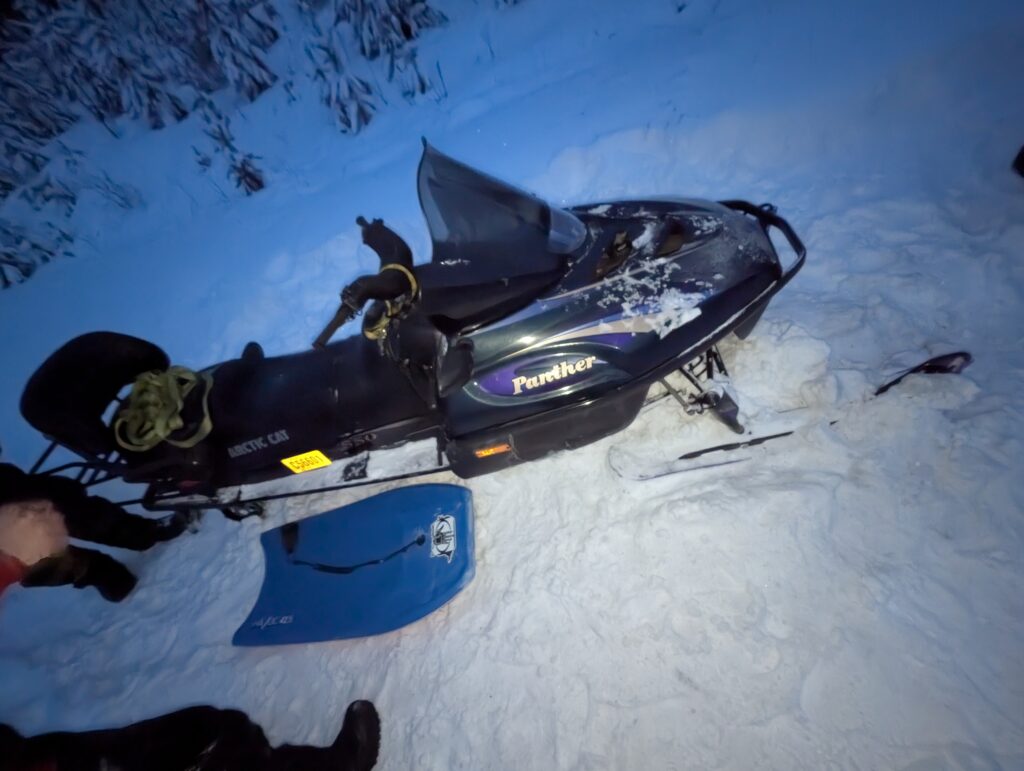
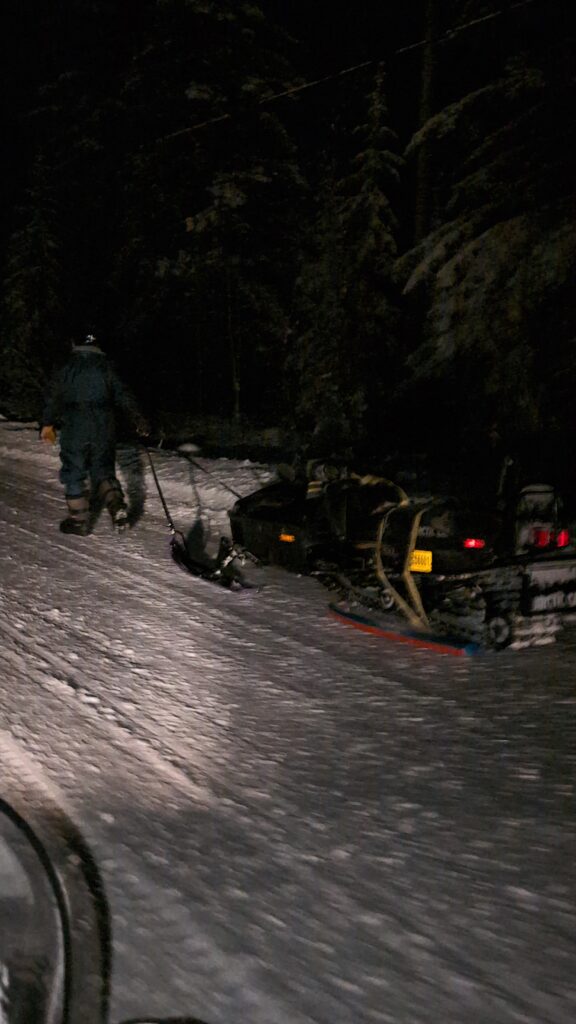
Key equipment for Rescue 1:
- Telecommunications devices (cellular and satellite!)
- Ratchet straps and tow straps
- Handwarmers
- Headlamps
- The willingness to ride on a snowmobile that is gliding on a bodyboard down a mountain with no brakes
Now at this point, we retired that machine until the off season when it could be fixed in above freezing temperatures.
With the other two machines, we headed out the next day….which ended like this:
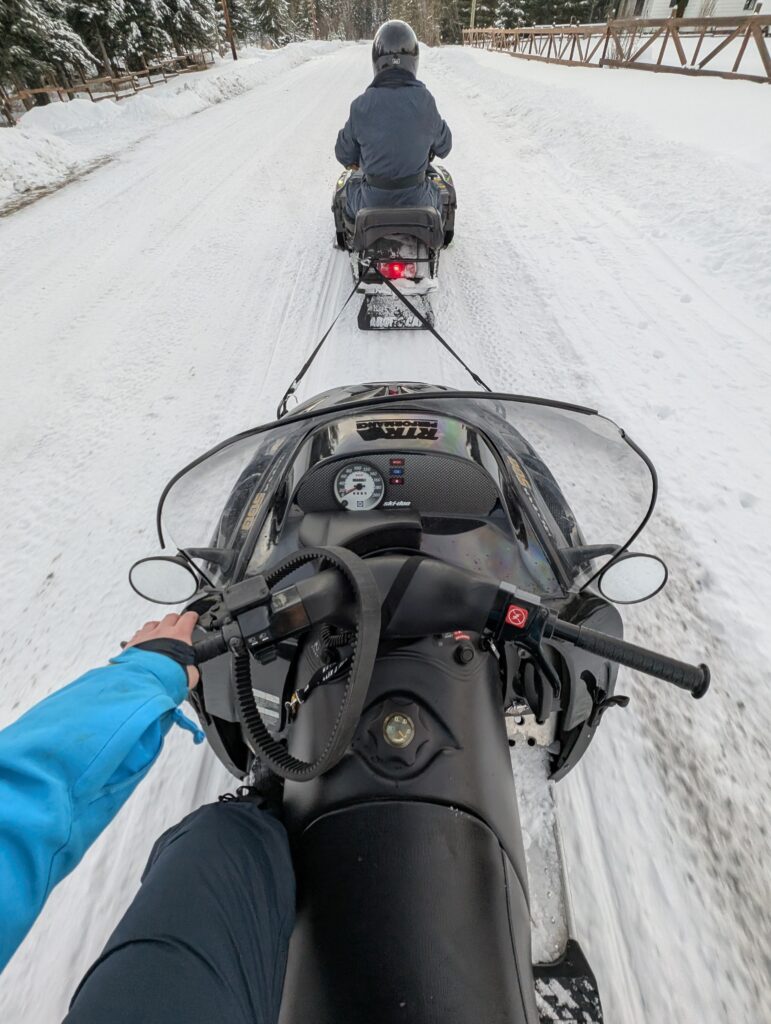
With my machine, you can pull the belt off and essentially be in neutral (without a belt, the track can not engage), meaning and I still could have brakes this time!
Additional key equipment for Rescue 2:
- Belt disengage tool (its this specialty contraption, thankfully it has its own spot in the sled)
- The core strength to prevent a much narrower and lighter sled from tipping over while being towed on ice
Will my sled be back on the trail next week when I head out again? Let’s hope!
The paper will read the latitude and longitude of the sites we chose, but only those who stumble upon this post will realize the adventure involved in getting those coordinates and water samples. Happy researching, my fellow fieldwork friends.